AwardInterview Professor James Ware honoured with American Heart Association ‘Medal of Honor’
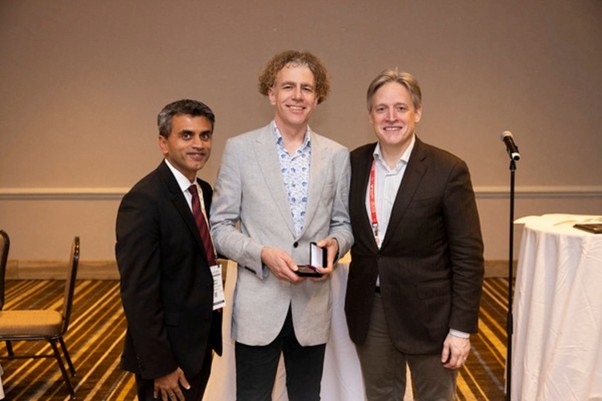
Professor James Ware, Professor of Cardiovascular and Genomic Medicine at Imperial’s National Heart and Lung Institute (NHLI), has been awarded the American Heart Association (AHA) “Genomic and Precision Medicine Medal of Honor”.
His work focuses on understanding the genetics of cardiovascular disease to improve diagnosis and treatment. He is also NIHR Imperial BRC Cardiovascular Theme Co-lead and Head of the Cardiovascular Genomics and Precision Medicine Research Group at the MRC Laboratory of Medical Sciences and honorary Consultant Cardiologist at Royal Brompton and Hammersmith Hospitals.
He spoke to our colleague about the award, his career and what’s next for genetics research.
How do you feel about receiving the award?
“It’s really nice, I feel honoured. I look at some of the people who’ve received this before and I feel honoured to be put alongside a lot of people that I respect and admire.
“I also feel a bit of a fraud because these aren’t one person’s work. These things have got to be seen as team prizes. I’m very grateful to my team and the people we work with, because you can’t really do human genetics in single centres. A lot of what I do is trying to build and maintain relationships with other groups and institutions. It takes quite a lot of work to do that, and I’m really grateful for people who trust us to share their data and work with us and do big science that we couldn’t do by ourselves.”
What inspired you to pursue a career in cardiology, and how did genetics become such a central part of your work?
“I was always drawn to physiology, especially the control systems – how biology maintains ordered systems. Cardiovascular physiology has a lot of that. You have a challenge like blood loss and there’s a whole bunch of feedback systems that make compensations to maintain blood pressure and cardiac output.
“I was interested in cardiac arrhythmia and sudden death and the electrophysiology of maintaining a steady rhythm versus what perturbations lead to arrhythmias. During that time, I met Stuart Cook and was struck by genetics – the opportunity to jump into completely new areas of biology.
“That attraction of finding new things lured me in. I was in the lab when next-generation sequencing arrived and it became possible to directly sequence the genomes of humans at bigger scale. So I flipped to studying human disease directly in humans – looking at naturally occurring variation in people with disease and people without disease and trying to spot patterns.”
How does your clinical work influence your research?
“My day job doesn’t link super closely – the data we study doesn’t necessarily come from my patients. But it gives me perspective on the need. I’m helping other clinicians solve challenges around which genetic variants are important and how to use genetic information to inform decisions.”
“The other thing I really enjoy is genetic counselling and education – patients wanting to understand what it means. That’s where I get the most satisfaction: when someone says, ‘I’ve never really got that,’ and you’ve helped them organise their thoughts and understand themselves.”
What advice would you give to early-career researchers?
“I give the same advice I got: do something you enjoy, work with people you enjoy working with. I’m very pro-collaborative science. I’d rather be a small part of something big and occasionally take my turn at leadership than lead a load of small inconsequential things. Take a risk, collaborate, share your data and ideas, and trust others will do the same.”
“Take time to think about what’s important. Opportunities present themselves and you can just do something because you can – but stop and think, what should we be doing, what needs to be done, not just what’s possible in the near term? Funders are prepared to fund good ideas if they’re the right ideas.”
Which moments stand out most in your career?
“I’ve enjoyed working abroad twice – that gives you a fresh perspective and new ideas. There have been grants I was excited to win and papers that took a long time to build. But mostly, I see my job as creating the right environment where people can flourish –giving them resources and support so they can think freely and exchange ideas.”
“The biggest buzz is when a group solves a problem together, or someone has a good idea and it works. A team isn’t clones of the same person – it’s the right mix of people with different ideas and perspectives. When we have a team away day and people are excited because what we’re doing is making a difference and they’ve got ideas for what’s next, that’s when I think it’s working.”
What are you currently working on?
“Right now, we’ve got an ambitious plan to create a transformative national dataset of rare genetic cardiovascular diseases. We’ve had funding from the MRC and NIHR. Our pilot projects are around national data linkage – building a register of everyone in the country who has a rare or genetic disease, writing to them for consent, and creating a copy of their data in an accessible research environment.
“Navigating UK governance is hard, but the NHS is big and connected. If you can make it work, you can do things you can’t do elsewhere. We want to make the most of that for patients with these diseases and use them as models for more common forms of disease.”